



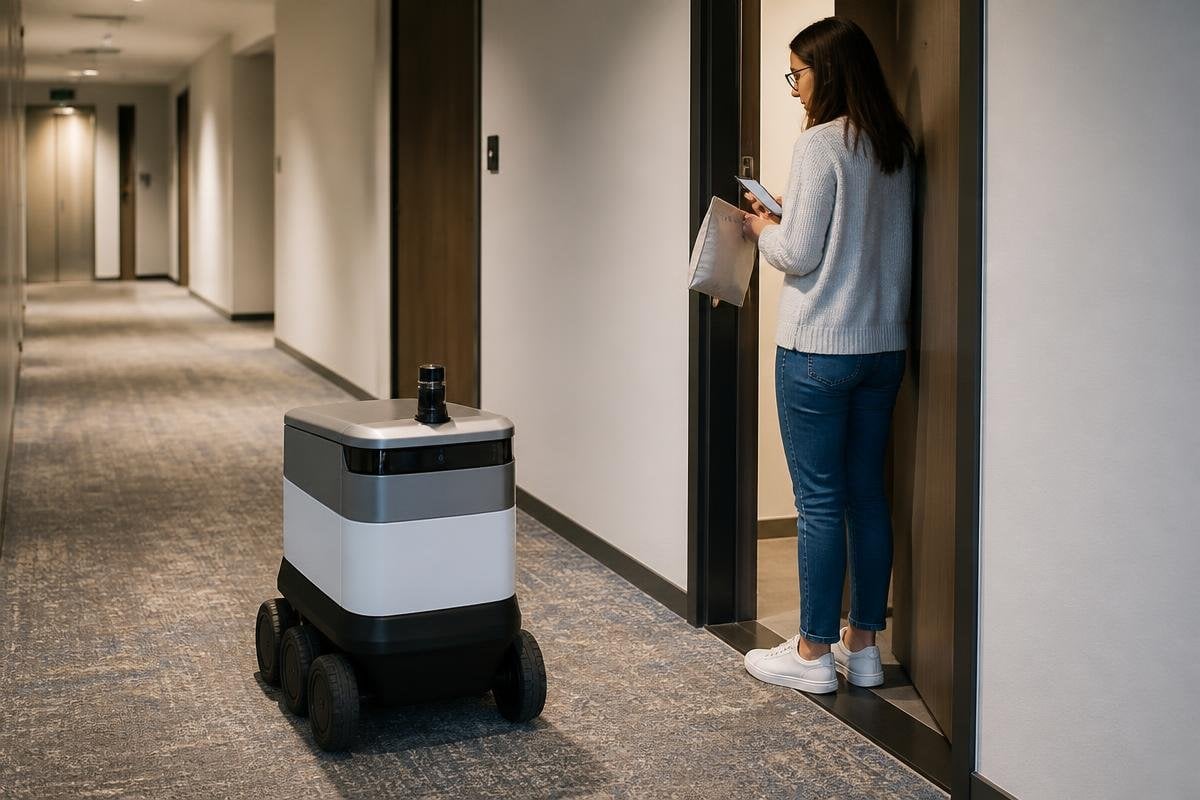
Indoor delivery robots can move food, parcels, medicine, or supplies through a building. Their hardest work starts when the route reaches a door, lift, crowded hall, or person who stops in front of them. The useful question is how much of that work a robot can handle without staff stepping in.
- A robot needs more than wheels and a map to finish an indoor delivery.
- Lift controls, doors, people, and dropped items shape the cost of each trip.
- Buyers should ask for records from the target building, not a smooth demo route.
The route is a chain of small tasks
An indoor delivery robot first needs a map of the building. It then uses sensors such as LiDAR, cameras, and wheel encoders to estimate its position as it moves. LiDAR measures distance with light, while wheel encoders track how far the motors have turned.
That basic route can still break at a doorway. The robot must detect the door, reach the right place, wait for it to open, and pass through without hitting the frame. A narrow corridor adds another test because a person and the robot may need to pass in limited space.
The same chain continues at a lift. A useful system needs a way to call the lift, select a floor, enter, leave, and recover if the doors close early.
That may require a building interface, a wireless connection, or a staff member with a badge. Each added handoff gives the robot another chance to stop.
People change the route
A building map describes walls and fixed objects. It cannot predict every person carrying a box, cleaning a floor, or standing in front of a room. The robot must slow down, choose a safe path around them, or wait until the route clears.
Waiting time matters because an indoor delivery usually ends at a person. The recipient may be late, the room may be locked, or the robot may need a code before it can open its storage compartment. A system that reaches the right floor but needs staff for every handoff has shifted the work rather than removed it.
An indoor delivery trial needs the building, route, handoff, and staff time recorded. Reports from Robot 24 can put those details beside the delivery claim, so the next section can test whether a full trip saves work or moves it to another person.
The business case needs a full trip
A buyer should measure the whole route, from loading to return. Travel speed matters less if the robot spends long periods waiting for lifts or searching for a recipient. Battery charging, cleaning, remote support, and failed deliveries also belong in the count.
The storage design sets another limit. A small compartment may suit meals or samples but fail for a larger parcel. Several compartments can serve more orders per trip, yet they add weight and make loading harder. The right choice depends on the items, floors, doors, and staff process in one building.
ROS 2 may handle the robot’s software connections, but it doesn’t solve every site problem. The building still needs safe lift access, clear delivery points, and a plan for blocked routes. I’d choose the robot that completes a full building route with the fewest staff interventions, even if its top speed is lower.
What remains unproven
Many indoor delivery tasks are controlled and repeatable. The harder test is a busy building during a full work period, with changing layouts and people who don’t follow a marked path.
Ask for logs from the exact type of site you run. A staged corridor can prove that the motors move; it cannot prove that the service will keep working when a lift is busy or a room changes use.
Before a purchase, check these points:
- Route records: Ask for completed trips on the same floor count and door types.
- Lift access: Confirm how the robot calls, enters, and exits each lift.
- Human help: Count the staff actions needed for a normal delivery and a failed one.
- Cargo fit: Test the largest item, the smallest item, and the loading process.
- Recovery plan: Check who handles blocked routes, low battery, and a recipient who isn’t there.
Those checks turn a broad promise into a site decision. They also tell you where a pilot should start: one route, one delivery type, and a clear record of every stop.
Indoor delivery robots have a practical path ahead, but it runs through building access and staff workflow. The next useful proof is a full route log showing how many deliveries finish without human help.